Guide: The optimal chassis for your motorhome
When buying a motorhome, there are countless decisions to make. Often, it’s the visual details that are decisive in the end. But if you want to travel not only in a ‘nice’ and functional, but also in a comfortable and safe motorhome, you should definitely consider the right chassis. Frequently overlooked, the quality of the running gear ensures you and your loved ones don’t experience a bumpy ride and safely reach your destination.
But how does a running gear actually work and what makes a truly good chassis? Read on for the key facts.


Chassis basics
Structure and individual components
When we talk about the chassis, we mean the load-bearing part of a vehicle – the section on which the body, engine and transmission are mounted. The running gear is a component of every chassis.
The running gear itself includes all parts that make up the vehicle technology. These are, on the one hand, elements that provide damping, such as suspension and shock absorbers. On the other, it includes the wheel guidance, including wheel suspension, wheels, wheel bearings, axles and, of course, brakes and steering.
Safe travel
To achieve this, the chassis, axle, wheel suspension and suspension of your motorhome need to do a good job. A high-quality running gear stands out for contributing to driving stability, and can compensate for possible weaknesses of a motorhome, such as a long rear overhang and a high centre of gravity.
High-quality shock absorbers and suspension and the perfect interaction between them also define a good chassis. They don’t just provide stability on bends, bumps or with uneven loads – to keep the vehicle level while driving and absorb even stronger shocks, the two must work together in all conditions. While the suspension absorbs the kinetic energy, the shock absorber acts as its direct counterpart, ensuring that the absorbed energy is ‘damped’ and the vehicle does not start to bounce due to vibrations.
If all chassis components are perfectly coordinated, this will have a positive effect on driving stability, road holding, and directly impact the safety of your motorhome.


Comfortable travel
In addition to safety, a chassis must also offer a relaxed ride and a certain level of comfort. This can’t always be achieved with standard chassis. That’s because, with most manufacturers, the body of a motorhome is mounted as standard on the chassis of a light commercial vehicle – often a Fiat Ducato as the base vehicle.
There is in principle nothing wrong with using such a light commercial vehicle chassis as a foundation for a motorhome conversion. These vehicles are designed as robust, low-maintenance workhorses, with the chassis built for reliably transporting heavy loads from A to B. The solid axles with leaf springs and extra shock absorbers used in most vans are perfect for this job – they are sturdy and dependable. However, comfort tends to fall by the wayside with these standard chassis, which is no surprise since, as mentioned above, they were designed for work and not as luxury vehicles. When it comes to comfort and relaxed travel, standard chassis aren’t the first choice.
AL-KO VT, as a running gear specialist, identified this issue almost 40 years ago and has since offered the AL-KO VT chassis, enabling you to travel not only safely but very comfortably. Suspension and damping technology optimally matched to this chassis can further maximise comfort when travelling.
What makes the AL-KO VT chassis different from conventional series production running gear
More than a quarter of a million of all chassis installed in motorhomes come from AL-KO VT. One of the key advantages of these chassis, both then and now: compared to the original frame, they are wider and lower. This influences not only the driving characteristics of the motorhome but also enhances both safety and comfort.
Another key point is AL-KO VT’s proprietary axle with torsion bar suspension, fitted as standard on these chassis. It transforms knocks and bumps into gentle vibrations and is therefore superior to conventional suspension systems.

AL-KO VT chassis offer real improvements for motorhome owners
- Low centre of gravity: better road holding, improved driving dynamics, increased driving safety
- Vehicle can be made winterproof: the lowered frame allows the addition of a double floor as required for winterproofing.
- Lower motorhome body: less aerodynamic drag, lower fuel costs, greater safety
- Greater comfort on the road: the chassis comes with torsion bar axles and independent suspension as standard, providing enhanced comfort and improved road holding.
- Longer service life: hot-dip galvanising of the chassis provides long-term protection against corrosion and damage.
- Lightweight construction: lower fuel costs or, alternatively, higher payload due to the 100 kg weight saving of the chassis.
What defines the quality of a chassis?
Put simply: a high-quality chassis is one that makes safe and comfortable travel possible. At the same time, it should be resistant to weather and environmental influences, promising durability.
The suspension system as part of the running gear plays a major role in both road safety and comfort. Unfortunately, series production chassis often leave comfort lacking, since conventional suspensions are designed primarily for longevity and high loads rather than for comfortable driving. This can result in rattling crockery and a ride in which you feel every tiny bump – in the worst cases, with springs that have completely lost their elasticity after years of continuous strain.
There are several practical options for retrofitting your motorhome with efficient suspension systems. At AL-KO VT, you’ll find a wide selection, from mechanical to pneumatic suspension – not just for AL-KO VT chassis, but also for motorhomes with a standard chassis:
The ACS comfort strut replaces the standard strut on the front axle and consists of a special shock absorber and a coil spring. Impacts while driving are absorbed, steering precision, driving and rolling stability, and thus driving safety, are improved.
AL-KO VT Level Controller
The ALC guarantees an optimal ride height at the rear axle, regardless of the load, ensuring the necessary ground clearance at the rear and traction at the front wheels. It also compensates between the driver and passenger side, so that trim position and centre of gravity remain constant even when the load is unevenly distributed.
Fitting air springs to the rear axle
Usually, this means a so-called auxiliary air suspension. This is used in addition to the leaf springs and takes on part of the payload. It prevents the suspension from bottoming out and, in addition to more comfort and improved driving characteristics, also provides useful adjustment options – such as raising the rear by a few centimetres when boarding a ferry. Air springs can be retrofitted to many vehicles.
AL-KO VT Air Plus
With the manual auxiliary air suspension Air Plus, designed exclusively for AL-KO VT chassis, the air pressure in the bellows is adjusted by hand, allowing ground clearance and departure angle to be flexibly adapted to load and road conditions. This system reduces rattling at the rear axle and improves trim overall.
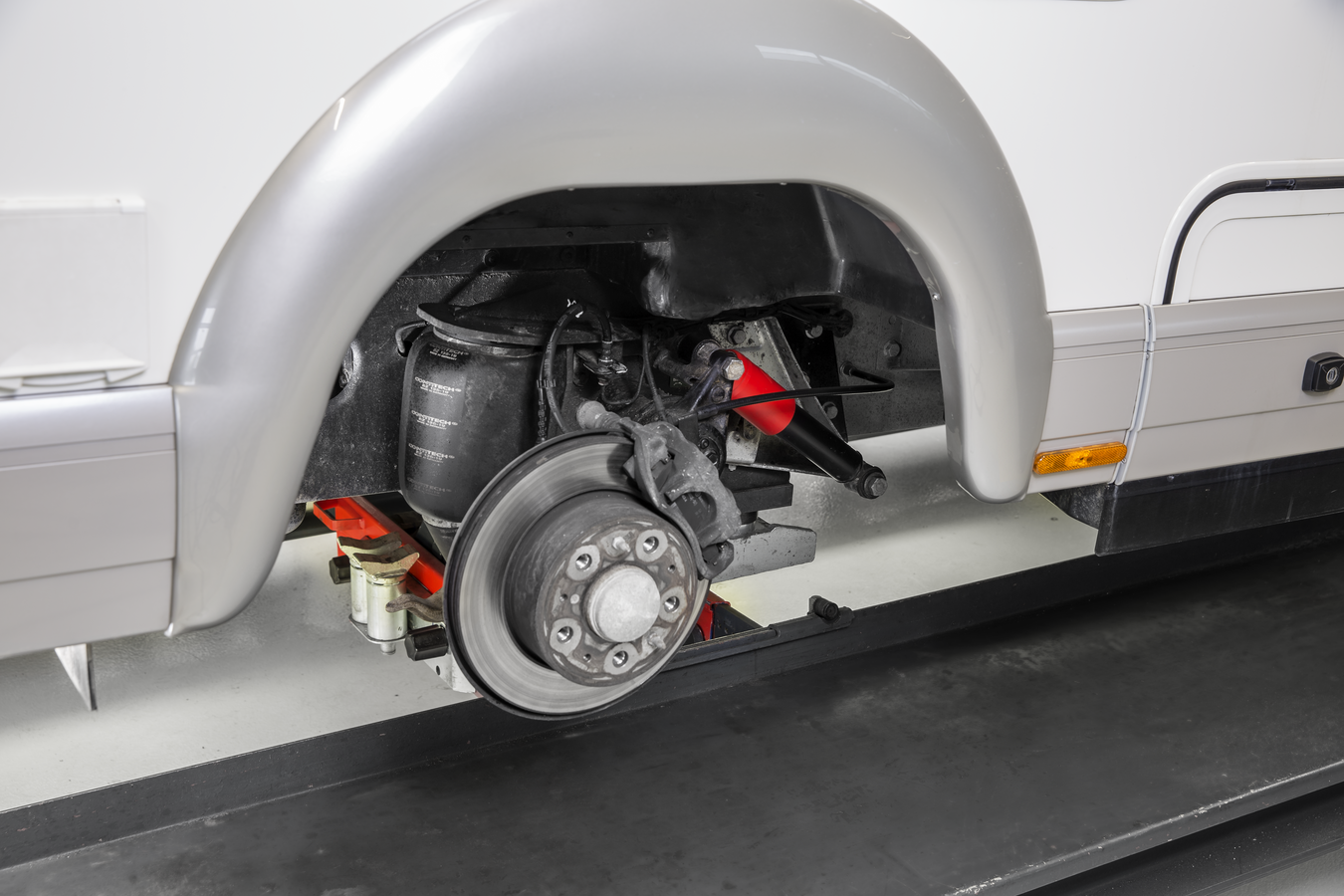
Equipping the vehicle with full air suspension
With this system, air bellows are installed on either both the front and rear axle, or just on the rear axle, providing fully automatic suspension. This ensures your vehicle always has optimal road holding and ride comfort.
AL-KO VT Air Premium X2
The Air Premium X2 full air suspension system is controlled via remote control and ensures automatic levelling of the rear axle when the load is uneven. This increases ground clearance and improves the departure angle – or the rear can be lowered to make loading more comfortable. The Air Premium X2 is maintenance-free and also offers the option of upgrading to the Air Premium X4 at a later date.
AL-KO VT Air Premium X4
The automatic full air suspension system Air Premium X4 is installed on both the front and rear axle and is the absolute “top class” among suspension systems. The X4 automatically levels your vehicle regardless of load, both when driving and when stationary. The ‘off-road function’ can provide up to 12 cm of diagonal compensation. This system is also maintenance-free and gentle on the body. Like its ‘little brother’ X2, the X4 is suitable for vehicles with ESP.
Find out more
No matter which option you choose – the investment is worth it. On the one hand, all passengers benefit from particularly quiet and relaxed journeys. On the other hand, it’s an important safety factor that, in future, the vehicle can be steered easily and comfortably regardless of road conditions.
If you’d like to get straightforward advice on which solution might suit you and your vehicle, just contact us – the AL-KO VT experts will be happy to assist you!
